Full analysis is selected. Choose Quick brief to scan the key points first.
WFN QUICK BRIEF · UNDER 1 MIN
The short version
MODE 2 OF 2
The record
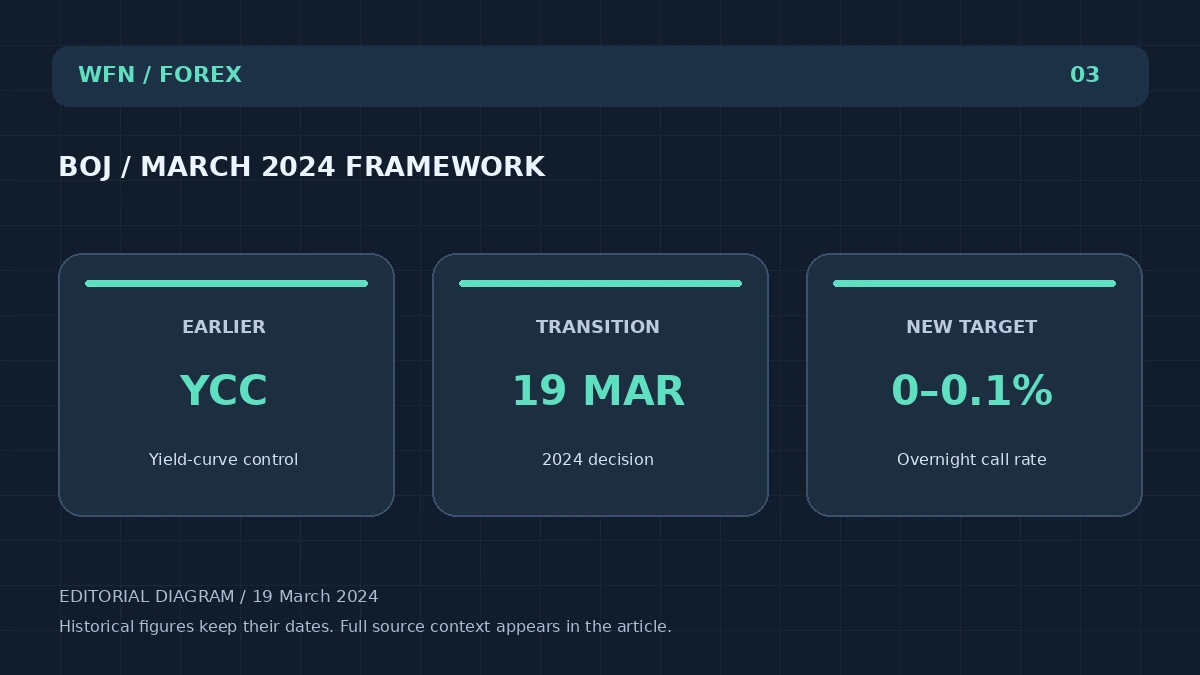
On 19 March 2024, the Bank of Japan announced changes to its monetary-policy framework. It judged that its earlier quantitative and qualitative easing with yield curve control, together with the negative interest-rate policy, had fulfilled their roles. The new guideline encouraged the uncollateralised overnight call rate to remain around 0–0.1%. Bank of Japan monetary-policy decision ↗
WFN analysis
For the yen, the useful distinction is between an immediate change and the path investors imagine after it. A small starting rate can coexist with a significant change in the way future decisions are assessed.
Next check
A retrospective comparison should preserve the original decision, the preceding policy settings and the relevant foreign-rate expectations. Use market prices with matching timestamps. If analysing carry, include financing costs, leverage and currency movement rather than presenting the Japanese overnight rate as the entire return calculation.
Quick Brief is a reading aid. The full article and source trail stay on this page.
WFN STORY COMPASS
Choose your reading angle
Move between the reported record, market context and open questions. Status labels keep claims distinct from findings.
All context layers are visible. Choose a lens to jump to that part of the story.
MARKET CONTEXTWFN EDITION · 14 OCTOBER 2026
Editorial noteSource-based explanation with original WFN analysis. Historical records retain their dates. Original WFN editorial diagram; it is not a live market chart.
WFN REALITY LEDGER
What is on the record?
Primary-source analysis
Dated official record / historical or technical explainer
The cited record establishes the documented event. Proposals, technical announcements, allegations and orders retain their stated status; WFN Analysis is editorial interpretation.
The BOJ’s March 2024 decision replaced negative-rate and yield-curve-control settings with a short-term rate framework.
01 · VERIFIED RECORD
The verified record
On 19 March 2024, the Bank of Japan announced changes to its monetary-policy framework. It judged that its earlier quantitative and qualitative easing with yield curve control, together with the negative interest-rate policy, had fulfilled their roles. The new guideline encouraged the uncollateralised overnight call rate to remain around 0–0.1%. Bank of Japan monetary-policy decision ↗
The decision marked a framework transition. The quoted range belongs to that March 2024 decision and should not be read as Japan’s current policy rate.
02 · WFN EDITORIAL ANALYSIS
Why it matters
For the yen, the useful distinction is between an immediate change and the path investors imagine after it. A small starting rate can coexist with a significant change in the way future decisions are assessed.
An exchange rate also reflects relative conditions. A Japanese policy adjustment must be considered alongside foreign funding rates, expectations and positioning. The framework announcement by itself cannot establish whether yen appreciation was inevitable or whether a carry trade became unprofitable. Those claims require additional evidence and a clearly specified holding period.
03 · WHAT TO CHECK NEXT
What to check next
A retrospective comparison should preserve the original decision, the preceding policy settings and the relevant foreign-rate expectations. Use market prices with matching timestamps. If analysing carry, include financing costs, leverage and currency movement rather than presenting the Japanese overnight rate as the entire return calculation.