Full analysis is selected. Choose Quick brief to scan the key points first.
WFN QUICK BRIEF · UNDER 1 MIN
The short version
MODE 2 OF 2
The record
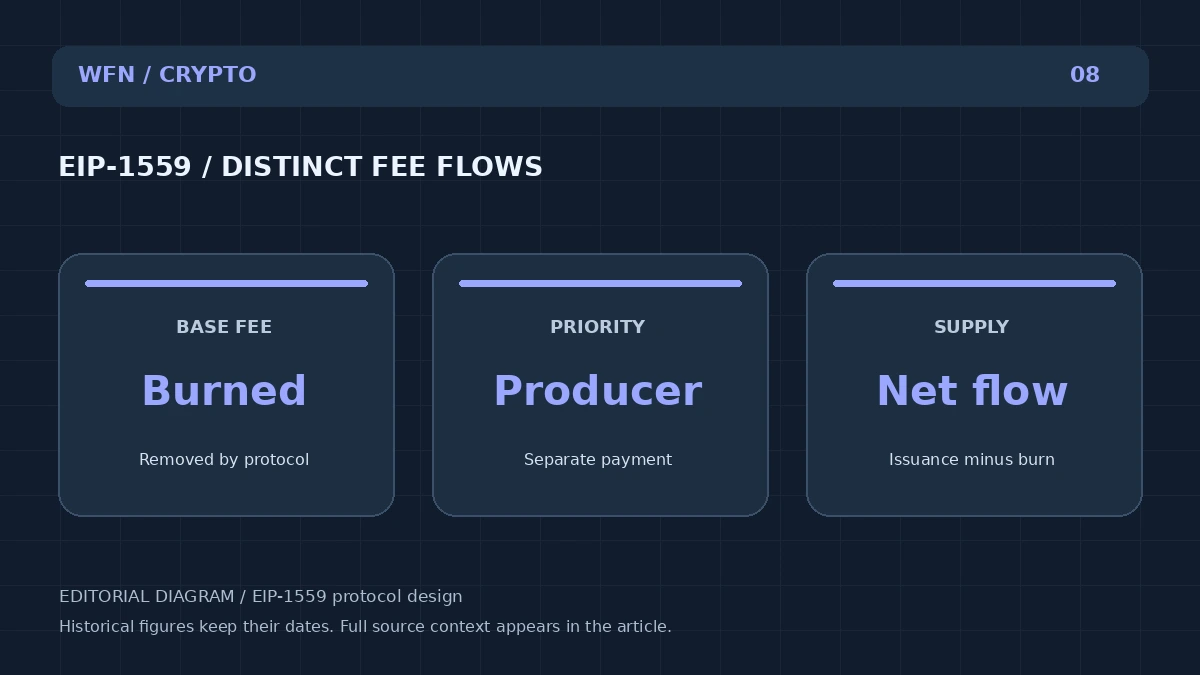
EIP-1559 specifies a base fee that adjusts with block utilisation relative to a target. The base fee is burned rather than paid to the block producer. A separate priority fee compensates the producer, and the transaction format allows the sender to set a maximum fee. Ethereum Improvement Proposal 1559 ↗
WFN analysis
A supply argument needs a time window and two sides of the ledger. Removing units through fees and adding units through issuance are distinct flows. Subtracting one from the other can describe net supply change, but neither flow alone establishes a permanent monetary condition.
Next check
For an empirical claim, obtain issuance and burn data for the same chain and dates, and explain the unit used. For a payment-cost comparison, distinguish the offered maximum from the fee actually charged. A transaction fee, token supply change and investment return should each have their own evidence.
Quick Brief is a reading aid. The full article and source trail stay on this page.
WFN STORY COMPASS
Choose your reading angle
Move between the reported record, market context and open questions. Status labels keep claims distinct from findings.
All context layers are visible. Choose a lens to jump to that part of the story.
MARKET CONTEXTWFN EDITION · 14 OCTOBER 2026
Editorial noteSource-based explanation with original WFN analysis. Historical records retain their dates. Original WFN editorial diagram; it is not a live market chart.
WFN REALITY LEDGER
What is on the record?
Primary-source analysis
Dated official record / historical or technical explainer
Primary record / reference periodEIP-1559 protocol design
The cited record establishes the documented event. Proposals, technical announcements, allegations and orders retain their stated status; WFN Analysis is editorial interpretation.
Ethereum’s fee specification separates the burned base fee from the priority fee. Supply analysis also needs issuance over the same period.
01 · VERIFIED RECORD
The verified record
EIP-1559 specifies a base fee that adjusts with block utilisation relative to a target. The base fee is burned rather than paid to the block producer. A separate priority fee compensates the producer, and the transaction format allows the sender to set a maximum fee. Ethereum Improvement Proposal 1559 ↗
The specification establishes how this fee mechanism works. It does not promise that a fixed quantity of ETH will be burned every day or that total ETH supply must decline in every observation period.
02 · WFN EDITORIAL ANALYSIS
Why it matters
A supply argument needs a time window and two sides of the ledger. Removing units through fees and adding units through issuance are distinct flows. Subtracting one from the other can describe net supply change, but neither flow alone establishes a permanent monetary condition.
Consider a purely hypothetical period with 100 units issued and 70 burned: supply increases by 30. Reverse the amounts and supply decreases by 30. These are arithmetic illustrations, not Ethereum observations or forecasts. They show why a burn headline cannot replace a complete measurement.
03 · WHAT TO CHECK NEXT
What to check next
For an empirical claim, obtain issuance and burn data for the same chain and dates, and explain the unit used. For a payment-cost comparison, distinguish the offered maximum from the fee actually charged. A transaction fee, token supply change and investment return should each have their own evidence.