Full analysis is selected. Choose Quick brief to scan the key points first.
WFN QUICK BRIEF · UNDER 1 MIN
The short version
MODE 2 OF 2
The record
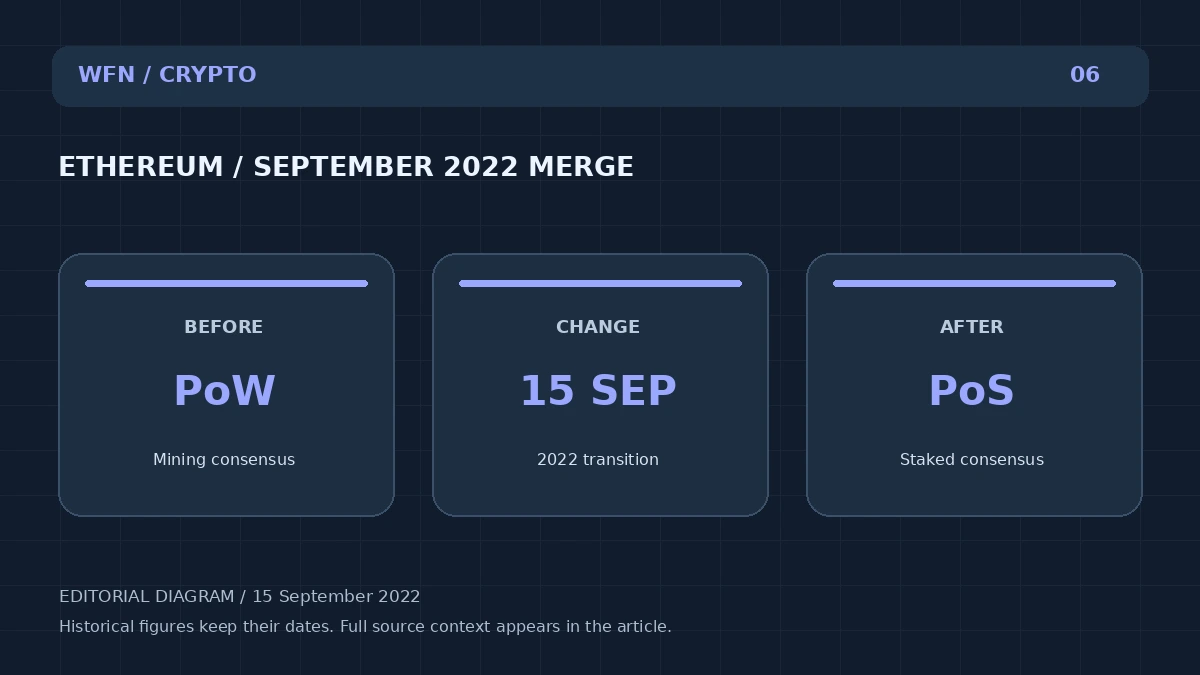
Ethereum completed the Merge on 15 September 2022, joining its existing execution layer with the Beacon Chain’s proof-of-stake consensus. Ethereum.org estimates the change reduced energy consumption by approximately 99.95%. The same documentation explains that the Merge did not significantly expand network capacity and was not designed to reduce gas fees. Ethereum.org: The Merge ↗
WFN analysis
The case is useful because one successful technical change can be mistaken for several unrelated promises. Consensus, energy demand, available block space and the price of using that space are different measurements.
Next check
When comparing pre- and post-upgrade data, identify the network and the metric. Electricity, carbon emissions and fees per transaction are not interchangeable. For users evaluating an upgrade announcement, check whether any action is actually required and use the project’s official documentation before following a request to migrate funds.
Quick Brief is a reading aid. The full article and source trail stay on this page.
WFN STORY COMPASS
Choose your reading angle
Move between the reported record, market context and open questions. Status labels keep claims distinct from findings.
All context layers are visible. Choose a lens to jump to that part of the story.
MARKET CONTEXTWFN EDITION · 14 OCTOBER 2026
Editorial noteSource-based explanation with original WFN analysis. Historical records retain their dates. Original WFN editorial diagram; it is not a live market chart.
WFN REALITY LEDGER
What is on the record?
Primary-source analysis
Dated official record / historical or technical explainer
Primary record / reference period15 September 2022
The cited record establishes the documented event. Proposals, technical announcements, allegations and orders retain their stated status; WFN Analysis is editorial interpretation.
The September 2022 Merge replaced mining with proof of stake. Its energy impact and transaction-capacity impact need separate explanations.
01 · VERIFIED RECORD
The verified record
Ethereum completed the Merge on 15 September 2022, joining its existing execution layer with the Beacon Chain’s proof-of-stake consensus. Ethereum.org estimates the change reduced energy consumption by approximately 99.95%. The same documentation explains that the Merge did not significantly expand network capacity and was not designed to reduce gas fees. Ethereum.org: The Merge ↗
Existing account balances and transaction history continued through the transition. A holder did not need to exchange ordinary ETH for a new version of the token.
02 · WFN EDITORIAL ANALYSIS
Why it matters
The case is useful because one successful technical change can be mistaken for several unrelated promises. Consensus, energy demand, available block space and the price of using that space are different measurements.
An analyst should therefore attach the energy estimate to its specific methodology and resist turning it into a fee forecast. A fee claim needs evidence about the relevant network, demand and capacity. A price claim requires an even wider argument; the completion of a protocol upgrade alone does not demonstrate a positive investment return.
03 · WHAT TO CHECK NEXT
What to check next
When comparing pre- and post-upgrade data, identify the network and the metric. Electricity, carbon emissions and fees per transaction are not interchangeable. For users evaluating an upgrade announcement, check whether any action is actually required and use the project’s official documentation before following a request to migrate funds.