Full analysis is selected. Choose Quick brief to scan the key points first.
WFN QUICK BRIEF · UNDER 1 MIN
The short version
MODE 2 OF 2
The record
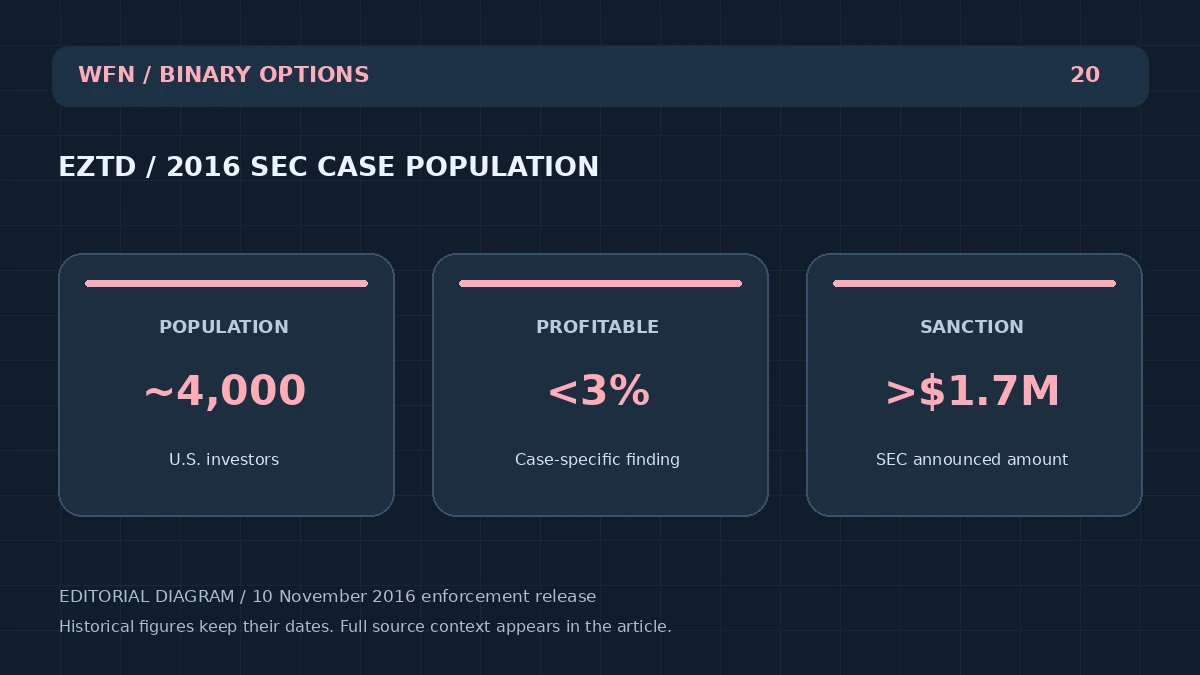
On 10 November 2016, the SEC announced that EZTD Inc. had to pay more than $1.7 million in connection with misleading investors about binary-options profitability. The SEC’s order found that fewer than 3% of approximately 4,000 U.S. investors who opened accounts made any profit on their investment. It also identified registration failures and a failure to disclose the greater potential to lose money. SEC press release 2016-236 ↗
WFN analysis
A marketing statement about profitable trading is incomplete without an outcome definition. Is it describing successful trades, profitable accounts, customers after fees or only selected testimonials? Those measures can differ sharply.
Next check
When assessing a profitability claim, ask for the period, population, treatment of closed accounts and whether costs are included. Match the calculation to the exact wording of the claim. Historical enforcement evidence can expose a reporting problem, but it cannot establish a present provider’s performance without its own verifiable records.
Quick Brief is a reading aid. The full article and source trail stay on this page.
WFN STORY COMPASS
Choose your reading angle
Move between the reported record, market context and open questions. Status labels keep claims distinct from findings.
All context layers are visible. Choose a lens to jump to that part of the story.
MARKET CONTEXTWFN EDITION · 14 OCTOBER 2026
Editorial noteSource-based explanation with original WFN analysis. Historical records retain their dates. Original WFN editorial diagram; it is not a live market chart.
WFN REALITY LEDGER
What is on the record?
Primary-source analysis
Dated official record / historical or technical explainer
Primary record / reference period10 November 2016 enforcement release
The cited record establishes the documented event. Proposals, technical announcements, allegations and orders retain their stated status; WFN Analysis is editorial interpretation.
The SEC found fewer than 3% of about 4,000 U.S. EZTD investors made a profit. That case-specific result challenges unsupported marketing claims.
01 · VERIFIED RECORD
The verified record
On 10 November 2016, the SEC announced that EZTD Inc. had to pay more than $1.7 million in connection with misleading investors about binary-options profitability. The SEC’s order found that fewer than 3% of approximately 4,000 U.S. investors who opened accounts made any profit on their investment. It also identified registration failures and a failure to disclose the greater potential to lose money. SEC press release 2016-236 ↗
The percentage belongs to the population described in that case. It is not a universal win rate for every binary-options contract.
02 · WFN EDITORIAL ANALYSIS
Why it matters
A marketing statement about profitable trading is incomplete without an outcome definition. Is it describing successful trades, profitable accounts, customers after fees or only selected testimonials? Those measures can differ sharply.
The difference is especially important when a product is presented through screenshots of winning trades. A visible win does not establish a customer’s overall result. A credible performance claim needs the complete relevant population and a method that does not quietly remove unsuccessful or inactive participants. These are editorial evidence standards, not a new statistic inferred from the enforcement release.
03 · WHAT TO CHECK NEXT
What to check next
When assessing a profitability claim, ask for the period, population, treatment of closed accounts and whether costs are included. Match the calculation to the exact wording of the claim. Historical enforcement evidence can expose a reporting problem, but it cannot establish a present provider’s performance without its own verifiable records.