Full analysis is selected. Choose Quick brief to scan the key points first.
WFN QUICK BRIEF · UNDER 1 MIN
The short version
MODE 2 OF 2
The record
The FIX Session Layer specification defines message-sequence handling and recovery behaviour. When an incoming sequence number is higher than expected, the receiving session processor requests retransmission according to the recovery rules. The specification also describes gap handling and the sequencing of resent messages. FIX Trading Community session-layer specification ↗
WFN analysis
Imagine a hypothetical disconnection after an order is submitted but before its execution report is processed by an internal ledger. Restoring communication answers whether messages can flow again. The broker still has to establish what happened to that order and whether the ledger records it once.
Next check
A recovery exercise should test the agreed FIX version and counterparty rules, then compare orders, executions and internal postings after reconnection. Use a deliberately interrupted test flow and verify the outcome rather than only the session status. Counterparty-specific implementation details should be documented before assuming that one recovery procedure works across every connection.
Quick Brief is a reading aid. The full article and source trail stay on this page.
WFN STORY COMPASS
Choose your reading angle
Move between the reported record, market context and open questions. Status labels keep claims distinct from findings.
All context layers are visible. Choose a lens to jump to that part of the story.
MARKET CONTEXTWFN EDITION · 14 OCTOBER 2026
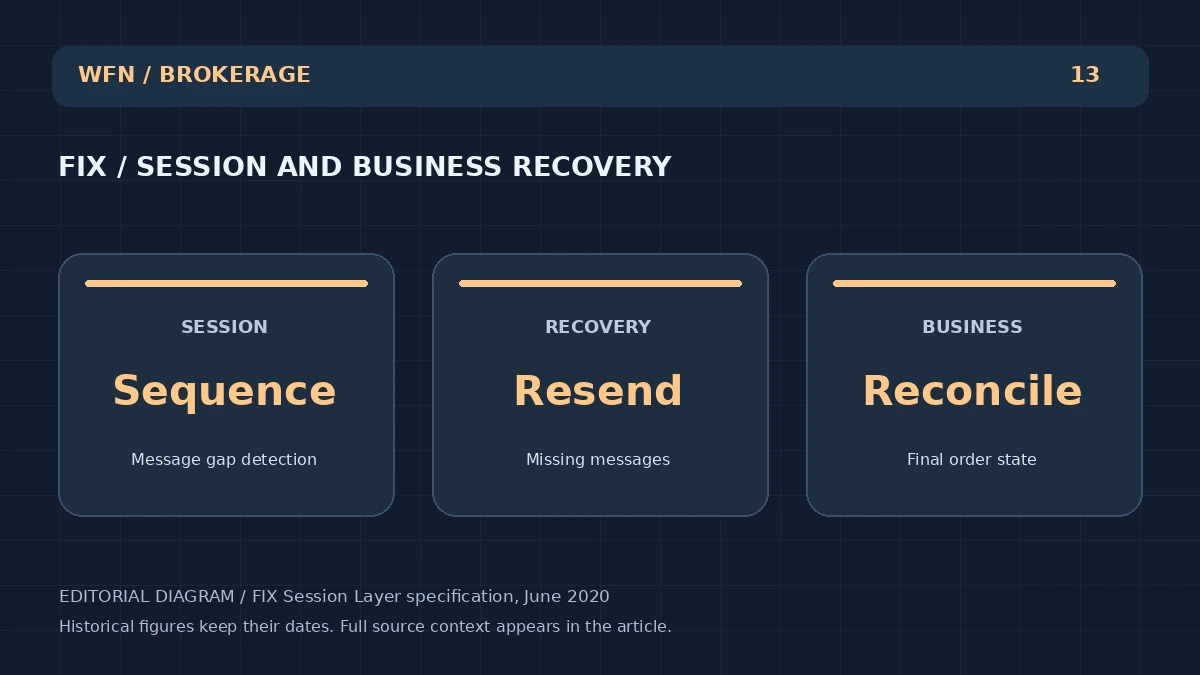
Editorial noteSource-based explanation with original WFN analysis. Historical records retain their dates. Original WFN editorial diagram; it is not a live market chart.
WFN REALITY LEDGER
What is on the record?
Primary-source analysis
Dated official record / historical or technical explainer
Primary record / reference periodFIX Session Layer specification, June 2020
The cited record establishes the documented event. Proposals, technical announcements, allegations and orders retain their stated status; WFN Analysis is editorial interpretation.
FIX sequence numbers help recover missing messages. Brokers still need application-level reconciliation to establish the final state of an order.
01 · VERIFIED RECORD
The verified record
The FIX Session Layer specification defines message-sequence handling and recovery behaviour. When an incoming sequence number is higher than expected, the receiving session processor requests retransmission according to the recovery rules. The specification also describes gap handling and the sequencing of resent messages. FIX Trading Community session-layer specification ↗
These mechanisms concern the message stream. A repaired session does not, by itself, demonstrate that every downstream business record has been reconciled.
02 · WFN EDITORIAL ANALYSIS
Why it matters
Imagine a hypothetical disconnection after an order is submitted but before its execution report is processed by an internal ledger. Restoring communication answers whether messages can flow again. The broker still has to establish what happened to that order and whether the ledger records it once.
This is an architectural distinction, not a claim of a flaw in FIX. Transport recovery, business identifiers and ledger controls serve different purposes. Treating a green connection indicator as proof of a fully recovered trading operation collapses those purposes into one misleading status.
03 · WHAT TO CHECK NEXT
What to check next
A recovery exercise should test the agreed FIX version and counterparty rules, then compare orders, executions and internal postings after reconnection. Use a deliberately interrupted test flow and verify the outcome rather than only the session status. Counterparty-specific implementation details should be documented before assuming that one recovery procedure works across every connection.