Full analysis is selected. Choose Quick brief to scan the key points first.
WFN QUICK BRIEF · UNDER 1 MIN
The short version
MODE 2 OF 2
The record
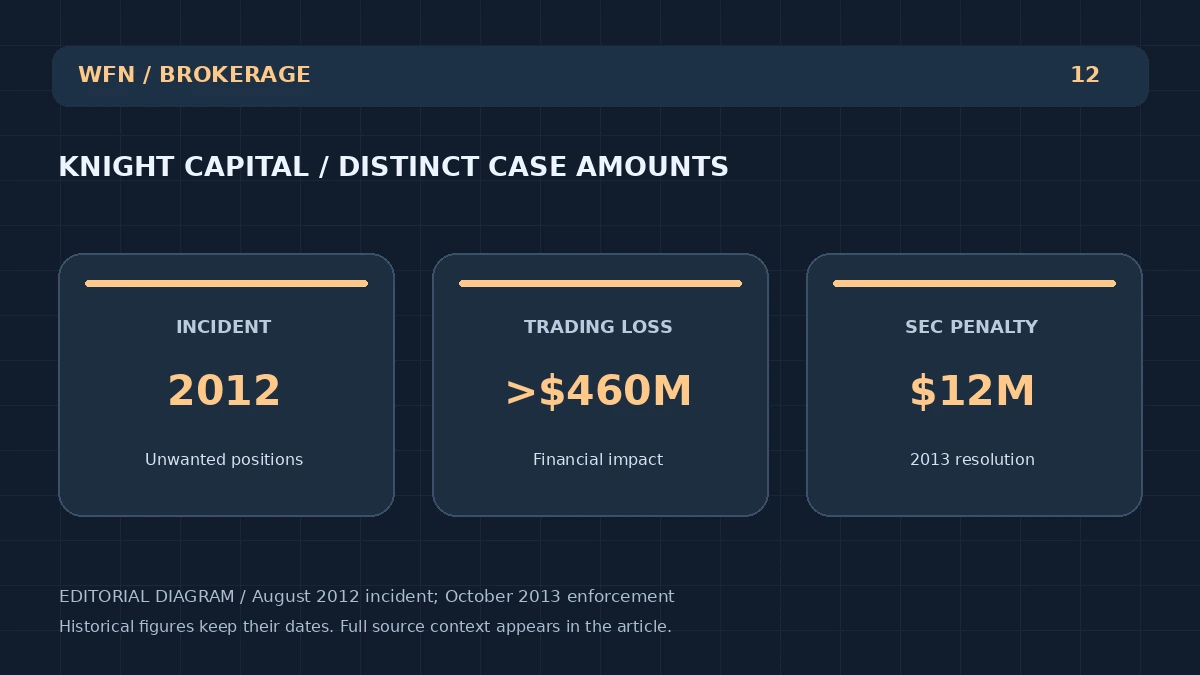
On 16 October 2013, the SEC announced an enforcement action against Knight Capital concerning an August 2012 trading incident. The release described trading in more than 397 million shares, several billion dollars of unwanted positions and losses exceeding $460 million. Knight agreed to a $12 million penalty and an independent review of relevant controls and procedures. SEC Knight Capital market-access release ↗
WFN analysis
The case gives a concrete reason to examine how production changes are deployed and constrained. A trading system can convert a software fault into market exposure before an ordinary business review has time to respond.
Next check
An operational review can trace a release from approval to every production instance, then test how abnormal orders are detected and halted in a controlled environment. Preserve evidence of the exercise and any unresolved exceptions. A successful software installation is only one checkpoint; the business also needs a way to limit damage if the installed software behaves unexpectedly.
Quick Brief is a reading aid. The full article and source trail stay on this page.
WFN STORY COMPASS
Choose your reading angle
Move between the reported record, market context and open questions. Status labels keep claims distinct from findings.
All context layers are visible. Choose a lens to jump to that part of the story.
MARKET CONTEXTWFN EDITION · 14 OCTOBER 2026
Editorial noteSource-based explanation with original WFN analysis. Historical records retain their dates. Original WFN editorial diagram; it is not a live market chart.
WFN REALITY LEDGER
What is on the record?
Primary-source analysis
Dated official record / historical or technical explainer
Primary record / reference periodAugust 2012 incident; October 2013 enforcement
The cited record establishes the documented event. Proposals, technical announcements, allegations and orders retain their stated status; WFN Analysis is editorial interpretation.
The SEC’s Knight Capital case links a costly trading incident to market-access controls, testing and the handling of production alerts.
01 · VERIFIED RECORD
The verified record
On 16 October 2013, the SEC announced an enforcement action against Knight Capital concerning an August 2012 trading incident. The release described trading in more than 397 million shares, several billion dollars of unwanted positions and losses exceeding $460 million. Knight agreed to a $12 million penalty and an independent review of relevant controls and procedures. SEC Knight Capital market-access release ↗
These are separate amounts: the trading loss measures the incident’s financial impact, while the penalty belongs to the enforcement resolution.
02 · WFN EDITORIAL ANALYSIS
Why it matters
The case gives a concrete reason to examine how production changes are deployed and constrained. A trading system can convert a software fault into market exposure before an ordinary business review has time to respond.
For a broker building controls, the key design question is where the system stops an unintended action. A dashboard showing abnormal activity is useful only if the operating process assigns responsibility and permits timely intervention. Testing, deployment consistency and exposure limits should be considered together, while recognising that the SEC case does not certify any particular modern architecture.
03 · WHAT TO CHECK NEXT
What to check next
An operational review can trace a release from approval to every production instance, then test how abnormal orders are detected and halted in a controlled environment. Preserve evidence of the exercise and any unresolved exceptions. A successful software installation is only one checkpoint; the business also needs a way to limit damage if the installed software behaves unexpectedly.