




Asian Markets Surge as Nvidia and Chipmakers Fuel the AI Trade
Asian Markets Surge as Nvidia and Chipmakers Fuel the AI Trade
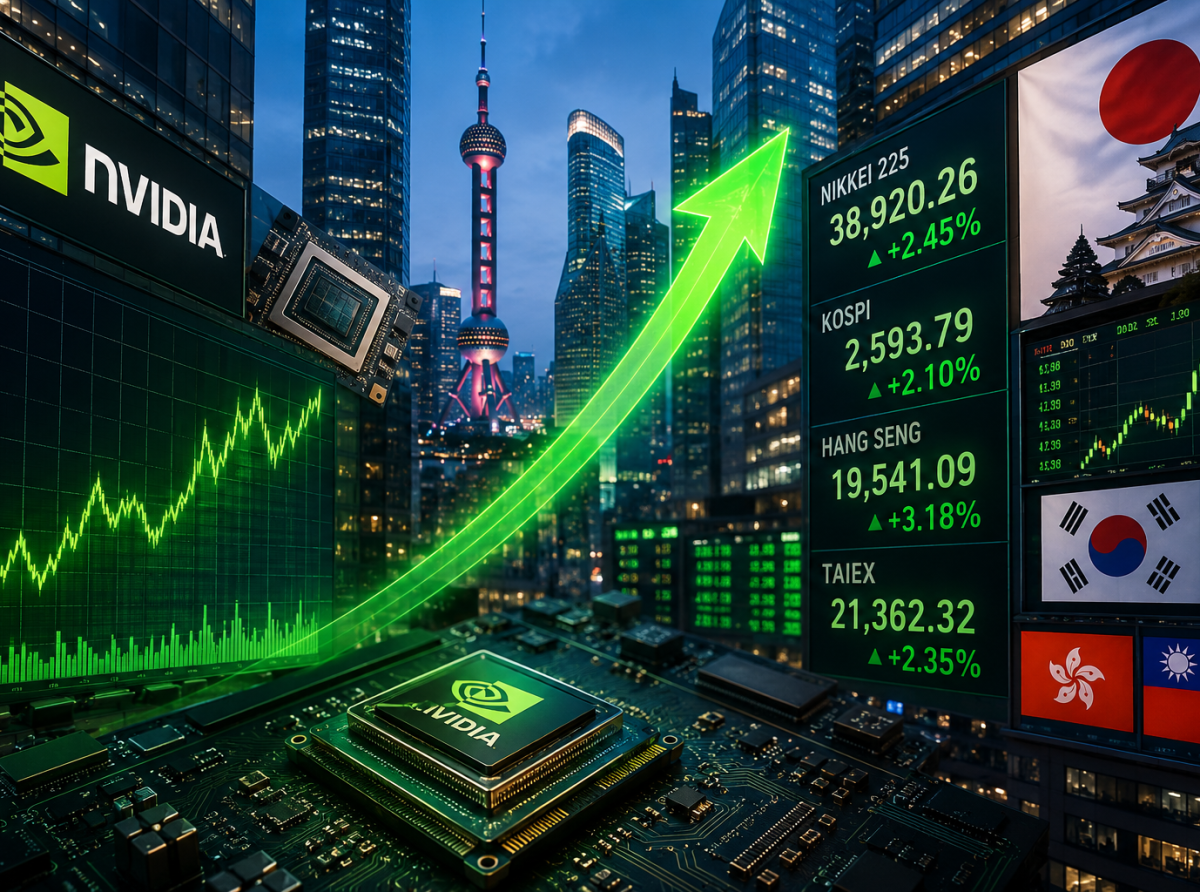
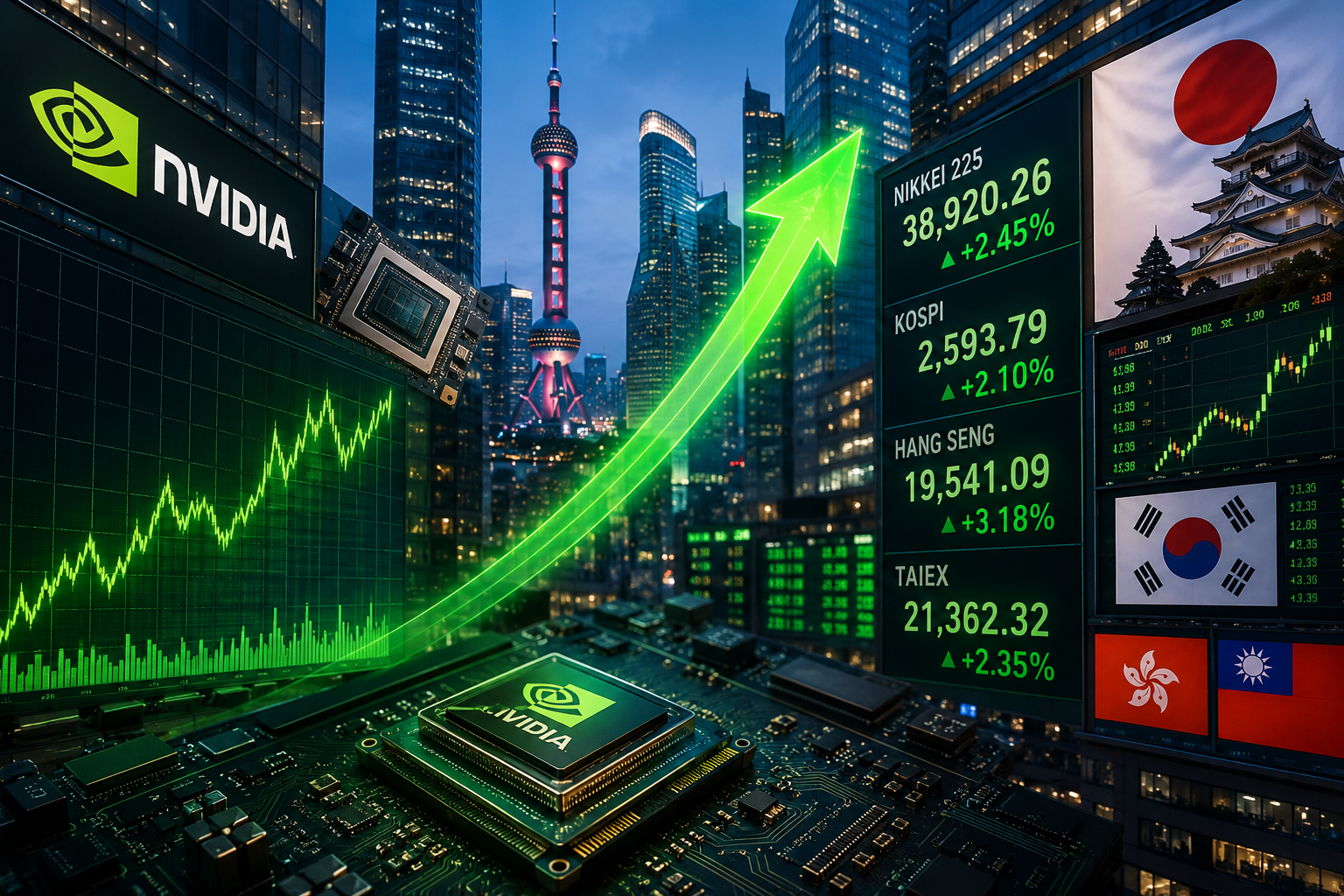
Asian equity markets are increasingly driven by the global artificial intelligence supply chain. Strong earnings and aggressive forward guidance from NVIDIA triggered a new wave of capital rotation into semiconductor and AI-linked stocks across Asia, lifting indices in Taiwan, South Korea, Japan and Hong Kong. Investors are treating the sector not as a cyclical rebound, but as the infrastructure layer of the next technological expansion cycle.
Nvidia becomes the global signal for AI capital flows
The market reaction to Nvidia’s latest results reflects more than enthusiasm around one company. Nvidia has effectively become a macro indicator for the entire AI ecosystem.When the company reports accelerating revenue growth and stronger demand for AI accelerators, markets immediately reprice expectations for suppliers, foundries and memory manufacturers connected to its production chain.
This creates what analysts increasingly describe as a “lead company effect.” The performance of one dominant player reshapes sentiment across multiple regions before local earnings are even published.
In practical terms, Nvidia’s guidance influences capital allocation far beyond the United States.
Taiwan and South Korea move first
The strongest reaction appeared in Taiwan and South Korea, where semiconductor manufacturing remains deeply integrated into global AI infrastructure.Taiwan Semiconductor Manufacturing Company benefits directly from increased demand for advanced chip fabrication. As AI training and inference workloads expand, dependence on cutting-edge manufacturing nodes continues to rise.
At the same time, Samsung Electronics and SK Hynix are gaining from the growing importance of high-bandwidth memory used in AI servers.
The memory segment, which historically suffered from cyclical oversupply, is now experiencing structural demand support from data center expansion.
Analytically, this is a critical distinction. Cyclical recoveries tend to fade. Infrastructure-driven demand cycles tend to last longer.
Asian Markets Surge as Nvidia and Chipmakers Fuel the AI Trade
Japan benefits from second-order AI effects
In Japan, the rally extends beyond chip production itself.Technology companies linked to industrial automation, precision equipment and semiconductor materials are benefiting from expectations that AI investment will cascade through the broader manufacturing ecosystem.
The Nikkei 225 reacted positively as investors priced in stronger earnings expectations across the technology sector.
Japan’s advantage lies in supplying the less visible but essential layers of semiconductor production — manufacturing equipment, specialty chemicals and industrial components.
This creates exposure to AI growth without relying entirely on consumer-facing technology demand.
Hong Kong and China: opportunity under pressure
Markets in Hong Kong and mainland China also received support from the broader AI rally, although the situation remains more complex.Chinese technology firms continue facing regulatory uncertainty and export restrictions tied to advanced semiconductor access.
Nevertheless, local companies such as Semiconductor Manufacturing International Corporation remain central to Beijing’s long-term strategy of technological self-sufficiency.
The AI boom is therefore creating two parallel dynamics: global optimism around demand growth and geopolitical pressure around supply control.
Who benefits the most and why
Samsung benefits the most in quarterly terms: it surpassed TSMC in semiconductor revenue and profit for the first time in 7+ years, driven by explosive demand for AI memory and record margins.TSMC remains the key beneficiary of the AI boom as the leading contract manufacturer of Nvidia and other AI accelerators, with the highest operating margin (58.1%) and strong revenue growth.
SK Hynix benefits directly from HBM memory supplies for Nvidia: record profits and plans to ship the latest AI memory chip.
SMIC benefits from domestic Chinese demand and import substitution, but the scale is much smaller; revenue growth is moderate, with key risks from US sanctions and tariffs.
Why investors continue rotating into chips
The semiconductor sector has effectively become the “picks and shovels” trade of the AI era.Investors increasingly view chipmakers not as speculative growth assets, but as infrastructure providers for a rapidly expanding computational economy.
This changes valuation logic.
Traditional concerns about hardware cyclicality are partially offset by the belief that AI adoption could sustain elevated demand for years rather than quarters.
As a result, capital continues rotating toward companies exposed to AI hardware, even as broader macroeconomic uncertainty remains.
Risks markets are still underestimating
Despite the rally, several structural risks remain.Supply chains are still highly concentrated geographically, particularly around Taiwan. Any disruption tied to geopolitics or export controls could immediately affect production capacity and investor sentiment.
Valuation pressure is another issue. Rapid inflows into semiconductor stocks increase the risk of sharp corrections if earnings growth slows or expectations become unrealistic.
There is also a growing dependency on continued AI infrastructure spending from hyperscalers and cloud providers. If capital expenditure cycles normalize faster than expected, momentum could weaken.
Analytical conclusion: the AI trade remains fundamentally strong, but increasingly crowded.
What makes this rally significant is that it reflects a structural transformation in global markets.
AI is no longer treated as an isolated technology sector. It is becoming a macroeconomic investment theme influencing commodities, electricity demand, cloud infrastructure and national industrial policy.
Asian markets are central to this transformation because they sit at the core of semiconductor manufacturing and assembly.
This positions the region not simply as a supplier base, but as one of the main beneficiaries of the AI expansion cycle.
The rally across Asian markets following Nvidia’s results reflects more than short-term optimism. Investors are repositioning around the belief that semiconductors have become foundational infrastructure for the next economic cycle. Taiwan, South Korea, Japan and parts of China are benefiting because they remain deeply embedded in the global AI supply chain. The key question now is not whether AI demand is growing, but whether the industry can sustain expectations that are rising almost as fast as the sector itself.
By Miles Harrington
May 22, 2026
Join us. Our Telegram: @forexturnkey
All to the point, no ads. A channel that doesn't tire you out, but pumps you up.
May 22, 2026
Join us. Our Telegram: @forexturnkey
All to the point, no ads. A channel that doesn't tire you out, but pumps you up.





Report
My comments